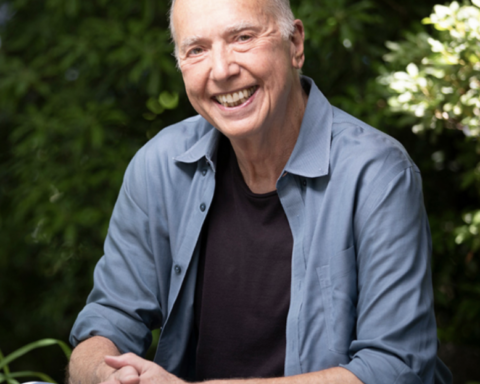
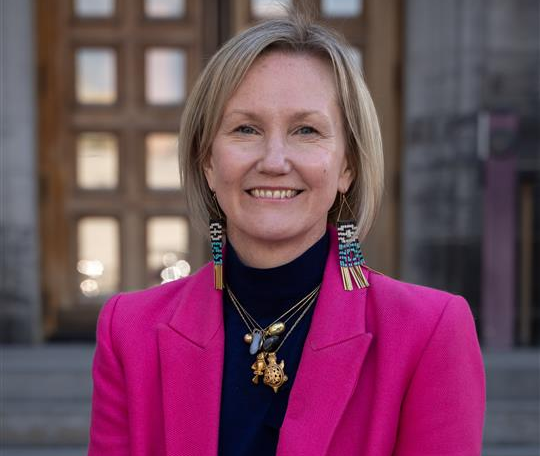
“I was always interested in understanding why people fight. That sort of almost anthropological curiosity of why people end up in that corner. Where [conflict] is the only option. That was a puzzle for me that I felt we need to figure out,” reflects Meredith Preston McGhie, a Canadian mediator and peacebuilder whose decades-long career has spanned frontline negotiation, policy, and diplomacy in settings as diverse as North-East India, Iraq, Kosovo, and Somaliland.
“What’s really profound to me is how deeply we lose who we are when we fight.”
For the past six years, McGhie has served as Secretary General of the Global Centre for Pluralism, a small but globally engaged institution which is rooted in the principle that societies thrive when they can turn diversity into strength. Founded by the Aga Khan and the Government of Canada, the Global Center for Pluralism works directly with governments, civil society, and educators, offering dialogue and mediation tools designed to bridge divides.
Before joining the Centre, McGhie served with the United Nations Development Program in Sudan and South Sudan, and worked closely on peace processes throughout Africa for the Centre for Humanitarian Dialogue, including the disarmament and reintegration efforts after the Comprehensive Peace Agreement, which marked the end of the Second Sudanese Civil War in 2005.
McGhie grew up in British Columbia and is the daughter of a Judge and a Social Worker. When she was 4-5, her parents quit their jobs and decided to bike across Europe. During this trip, she encountered refugees fleeing Iran after the fall of the Shah, in “packs of Mercedes.” The image stuck. She cites this as one of the early formative experiences that later inspired her career in peacebuilding.
While pursuing a bachelor’s degree in history at the University of British Columbia, she found herself especially drawn to courses on the history of conflicts and wars.
McGhie distills decades of field experience into lessons for building inclusive societies. Here are her most resonant insights.
1. Peacebuilding is an all-of-society effort
“We talk about the peacebuilders,” she says, “but the truth is, we all should be involved in that space,” she says.
“Peacebuilding is the stitching across divides that should be happening everywhere, all the time.” It isn’t a single event or an agreement, she stresses. It’s a societal process, a continuous weaving together of relationships and repairing of social fabric. It’s the work of teachers, community elders, activists, business owners, and everyday citizens. True peacebuilding happens in classrooms, kitchens, and community halls as much as in diplomatic rooms.
This holistic view lies at the heart of the Global Centre for Pluralism’s approach: peace isn’t a static outcome, but an ongoing collective practice of belonging, she says.
And it’s hard work.
“It’s easy to say that diversity is a strength,” she explains, “but it takes deliberate effort to make it true.”
The Centre’s research aims to show how policies, leadership, education, and civic spaces all shape whether people feel they belong.
In Colombia for example, it partnered with indigenous and Afro-descendant women to monitor implementation of the 2016 peace agreement, helping communities create their own consultation protocols rooted in local traditions, some guided by lunar cycles and oral storytelling.
One of McGhie’s critiques of the current peacebuilding landscape is its over-institutionalization. “We’ve technocratized something that’s deeply human,” she warns. Too many programs are bound by logframes and indicators, leaving little room for the organic, community-driven practices that make peace sustainable.
She points to Kenya’s Wajir initiative, a grassroots peacebuilding initiative led by women in North-East Kenya in the early 90s in response to inter-clan conflict, where government, grassroots organizations, elders and youth sat together to discuss their future. These dialogues, unfettered by formal frameworks, created a culture of problem-solving that endures till this day.
2. Listen for the said, the unsaid, and the unsayable
Years of mediation have taught McGhie that conflict resolution is as much about listening as speaking. She believes there are layers to every conversation: the said, the unsaid, and the unsayable.
A skilled mediator must be attuned to all three, she says. “You’ll often see emotion that doesn’t match what’s being said,” she explains. Someone says, ‘We should reform the history curriculum,’ and the room erupts because what’s really being discussed is identity, dignity, or belonging.
Understanding the deeper meaning beneath words requires empathy and contextual knowledge.
To McGhie, there is no such thing as a universal peacebuilding formula. “Too often, people say, ‘They did it in Colombia, why can’t they do it in South Sudan? But you can’t just transplant solutions.”
Instead, she encourages peacebuilders to look for the essence of what worked. The ingredients, not the recipe. Was it local ownership? Inclusion? A sense of dignity restored? Once identified, these threads can inspire, but never be copy-pasted.
3.Inclusion isn’t a checkbox, it’s a design principle
One of McGhie’s strongest convictions is that inclusion must go beyond tokenism [symbolic effort]. In her words,
“You have to figure out how to bring people along, even if they’re not in the room.”
When facilitating local dialogues in Nigeria’s Middle Belt, her team created “concentric circles” of engagement: core negotiators in one room, while other stakeholders, state authorities, women’s groups, and “potential spoilers,” met in parallel spaces. Each circle moved toward a shared goal, like gears in a clock.
“If you don’t take time to bring everyone along, the spoilers will appear when you least expect them.”
Across all her experiences, from Sudan to Colombia, McGhie has observed a universal truth: conflicts often grow from exclusion, from who gets to belong and who doesn’t. Even when disputes seem to be about land, wealth, or power, she says,
“underneath is always the question of who we are, and who gets to be part of ‘we’.”
This is why pluralism matters. It offers an antidote to othering, teaching societies to design systems where everyone can belong “not at the expense of one another, but in relationship with one another.”
“Everywhere I’ve worked, peace begins when people feel they can belong.”
Conflict, McGhie observes, often breeds a scarcity mentality, where for one group to have more, another must have less. “War and trauma set us up to see the world as zero-sum,” she says. Breaking that cycle requires helping people imagine that “the cake can be bigger for everyone.”
4. Hope is a discipline
Asked what traits make a good peacebuilder, McGhie laughs: “You need to be patient, creative and a bit of an obsessive detangler.” She compares mediation to working through a ball of tangled twine, gently pulling at one thread to see what loosens elsewhere. “If you pull too hard, you make the knot tighter. So you look at it from another angle, and another.”
After decades in the field, McGhie knows discouragement well. “We all get pessimistic,” she admits.
“But as a Scottish friend once told me, when pessimism is exhausted, all you have left is optimism.”
“You have to believe there’s a solution,” she adds.
She sees hope not as naïveté, but as discipline, a choice to keep standing alongside those who refuse to give up. “I don’t live in a conflict-affected society,” she says. “So I don’t have the right to be pessimistic. If someone in Sudan is still pushing for peace, then I’ll stand next to them.”
5. Out beyond right and wrong
Asked what kind of world she hopes to live in, McGhie quotes Rumi: “Out beyond ideas of wrongdoing and rightdoing, there is a field. I’ll meet you there.”
That field is pluralism in action. A space where people can see one another’s humanity and work through their differences without erasing them. “If more of us could step into that field,” she reflects, “including our political leaders, we’d be in a much better place.”
Pluralism, she teaches, is both the means and the goal. It’s an approach to seeing, listening, and building that makes belonging possible. While diversity is the mere existence of variety in a society, pluralism is a positive expression and response to that diversity. Pluralism encourages societies to make changes that lead to the recognition and belonging of diverse peoples. And it’s hard work!
In a world set up for division, her message to peacebuilders is: keep showing up, keep listening, and keep imagining that bigger field where we all belong.
“Out beyond right and wrong, there’s a field. Peacebuilders live there.”
This interview took place on 29.09.2025