Both Lebanon and Switzerland are deeply diverse societies, divided along sectarian lines, as well as linguistic ones in the case of Switzerland. Yet while Lebanon’s history remains marked by recurring conflicts, Switzerland has not experienced a major conflict since the 19th century. Why is that?
Lebanon, home to 18 religious sects, has witnessed countless massacres and wars between its communities over the past centuries.
Switzerland, another small and diverse country with four language groups and a history of sectarian divide, has not experienced conflict since the mid-19th century.
We spoke with Sean Mueller, Assistant Professor at the University of Lausanne, and Joseph Helou, Assistant Professor at the Lebanese American University, to better understand the factors that explain these different outcomes.
Sectarian divides: Lebanon vs Switzerland
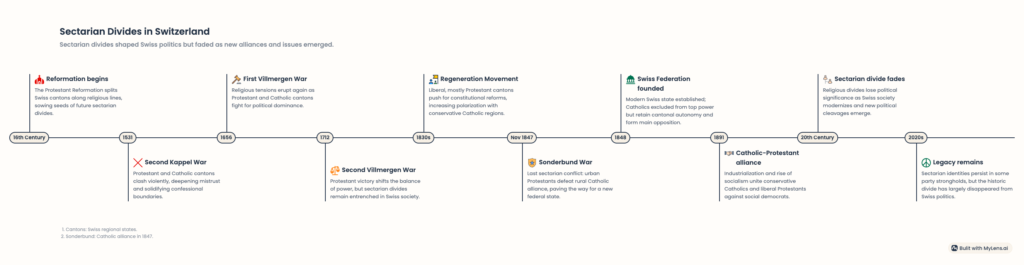
In Lebanon, sectarian conflicts still take place today, while Switzerland’s last sectarian war was in 1847.
Switzerland suffered many sectarian wars between the 16th and 19th centuries; its last one pitted the more urban, Protestant and trade-oriented reformers against the more rural, Catholic and agriculture-dependent conservatives.
Mueller explains that the first group won and created the Swiss federation in the modern sense. After the creation of the Swiss state in 1848, Catholics remained excluded from the top echelons of power but had their cantons and formed the most important political opposition to the more liberal Protestant elite, who, to their credit, had a secular approach to government matters.
Mueller noted that having down-to-earth persons in key positions at key moments was a lucky asset for Switzerland: “When the first constitution was drafted in 1847/48, the winners of the civil war still made many concessions to the losers”, he explained.
Soon after, he continues, industrialisation and the rise of social democrats pushed conservative Catholics and liberal Protestants to unite against the rise of socialism beginning in 1891, thereby creating conditions that helped prevent a resurgence of sectarian conflict. This, coupled with Switzerland’s federal system which allows for cantonal autonomy, as well as economic and social modernization, contributed to the end of sectarian tensions.
Today, the sectarian divide has all but disappeared, though some parties keep Catholic or Protestant areas as their strongholds.
In Lebanon, conflicts between sectarian groups have always been common in Lebanese history, including the massacres between the Druze and the Christians in the 19th century and the 15-year civil war from 1975 until 1990. The country’s sectarianism has not only caused bloodshed but political paralysis as well, as the interests of the different sectarian groups have always taken precedence over national interest. The country’s sectarian wars have never stopped, with its last internal conflict being in 2008 when the Shiite militia Hezbollah and its allies clashed with the Sunni Future movement and the Druze Progressive Socialist Party in the capital Beirut. Moreover, on October 14, 2021, Lebanon also witnessed armed clashes for a few hours between Hezbollah and the Amal Movement on one side and gunmen allegedly associated with the Christian Lebanese Forces on the other side.
What about linguistic divides in Switzerland?
Switzerland’s linguistic divides are even less meaningful than its sectarian ones, as they never led to conflict. Tensions were never as high as to lead to violent clashes between the four language groups, much less to armed militias or secessionist demands, according to Mueller. The country’s cantons cut across language divides, which weakens linguistic identity: there are two bilingual French and German cantons, one bilingual German and French, and one trilingual German, Italian and Romansh. In summary, the Swiss linguistic divisions have never evolved into fully developed “ethnic” identities.
Social contract, power-sharing
Regardless of the nature and the severity of these sectarian and linguistic divisions, both countries have adopted completely different models to deal with their divided societies.
Lebanon adopted the consociationalism system, which means that agreements among the leaders of the major sects (Maronite, Shia, and Sunni) are always necessary for any important decision to be taken.
This structure was first agreed upon in the 1943 National Pact, then amended in the 1991 Taif Agreement following the civil war, and reconfirmed in the Doha Agreement in 2008 after the aforementioned sectarian clashes.
Lebanon’s experience with the power-sharing arrangements is very much subject to the whims of Lebanese politicians, Assistant Professor at the Lebanese American University Joseph Helou says. He added that if Lebanese politicians are not satisfied with the share of their parties in the government, they start to negotiate in a bid to change it, and “this is one of the factors that lead to instability within the Lebanese power-sharing system”, he says. According to Helou, “every time [there is disagreement], the whole system gets paralyzed: our watchdogs, our institutional watchdogs, the legal bodies, the central investigation, the civil service, and so on and so forth.”
There are also disagreements over Lebanon’s identity and orientation and what its international relations should look like. On one hand, Hezbollah and its allies push for a pro-Iran Lebanon that is critical of US policies and supportive of resistance movements in the region. On the other hand, other parties, like the Lebanese Forces for example, aim for the country to align with the Western camp.
Meanwhile, in Switzerland, while there is no explicit social contract between the language groups and the state, there are lots of different institutional elements that together make members of the four groups belong to one Swiss nation regardless of linguistic differences; the first and most important of which is federalism.
Mueller explains that the “26 Swiss cantons are today little states in the sense that each has its own constitution, flag, tax revenue, parliament, government, police force, hospitals and universities, etc…”. But more importantly, Switzerland also has a federal constitution, government, federal-level taxes, and institutions. In other words, these cantons have strong autonomy but are still bound together under the federal framework.
A second core element is direct democracy: everywhere in Switzerland, citizens vote on specific issues all the time, at national, regional, and local levels. “Institutional arrangements were key to forging a common Swiss identity,” Mueller sums up.
Geopolitical location, foreign intervention
To explain the opposing circumstances in both countries, it is also important to note the “pure luck” factor, Mueller said, noting Switzerland’s “chance” in terms of its location and neighbors. According to him, the Swiss were “aided by more or less friendly, or indifferent in key moments, neighbours.”
He added that the fact that next-door France, and to some extent Italy, is very unitary also helps, as the Swiss-French minority, who are culturally influenced by France, is often “the one who calls for Switzerland’s centralisation the most vigorously”, as they view France’s centralized system as a positive example.
Switzerland has also adopted a policy of neutrality in international politics since the 16th century, which was formalized in the 1815 Treaty of Paris. “Switzerland tried to immunize itself, even during World Wars I and II, and post-World Wars. It managed to have a long history of immunity from conflict,” Helou said.
Meanwhile, Lebanon is very much influenced by the conflictual and turbulent region in which it finds itself. Helou listed the Ottoman era, the French mandate, up to Egypt’s leader Gamal Abdel Nasser’s position versus the non-Arabist, the Lebanese civil war, and post-war Lebanon. Lots of states, such as the US, Syria, Iran, and Saudi Arabia, interfered by supporting various Lebanese political parties.
These issues continued to characterize the region till this day and have had a toll on Lebanese politics and on the shape of the Lebanese state, according to Helou.
Is federalism a solution for Lebanon?
If Switzerland’s federal model succeeded, does that mean that Lebanon’s solution rests in federalism?
Helou believes that there are requirements that should first be met before this option can be considered for Lebanon: “There must be a united monetary economic policy that represents the federal state, and a common foreign relations and defense that unites everyone, both of which are not there.” Helou’s concern is that the moment this federal structure is imposed, there will be “several states within the country, each of which adopting its own international relations, defense, and foreign policy.” The Assistant Professor said that if this happens, it “would be a catastrophe.”
Lebanon at a Glance
- Location: Middle East, on the eastern Mediterranean coast
- Superficy: 10,452 km2
- Population: ~6 million (Including around 1.8 million refugees, most of them Syrian, the highest proportion per capita in the world)
- Main Communities among 18 recognized sects: Christian Maronite, Christian Orthodox, Sunni Muslim, Shia Muslim, Druze.
- Political System: Confessional power-sharing
Switzerland at a Glance
- Location: Central Europe, bordered by France, Germany, Italy, Austria, Liechtenstein
- Superficy: 41,285 km2
- Population: ~9 million (World Bank, 2024)
- Main Communities: German-, French-, Italian-, and Romansh-speaking groups
- Political System: Federal republic with direct democracy and power shared among cantons